


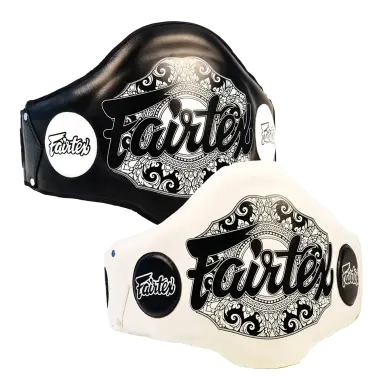


Strike shields for boxing and combat sports
Discover our selection of strike shields to boost the power, accuracy, and technique of your punches and kicks. Essential for training with a coach or partner, these pieces of equipment let you work on striking in many disciplines: boxing, kickboxing, Muay Thai, karate, Krav Maga, and other combat sports.
At Budo-Fight, you'll find different types of gear: straight strike shields for direct hits, curved strike shields for uppercuts, low-kick shields and coach's strike belts.
Each model meets specific needs and allows you to tailor your drills to the practitioner's level and goals.
Why use a strike shield in training?
Strike shields offer a large, stable striking surface, making them especially useful for developing power while maintaining good accuracy.
Unlike focus mitts, which are mainly used for speed, coordination, and precision drills, strike shields are designed to absorb more powerful impacts, depending on their build and thickness.
They are especially useful for:
Developing punching and kicking power.
Improving accuracy by targeting a defined area.
Practicing technical combinations.
Building coordination and explosiveness.
Varying drills with a coach or partner.
Preparing practitioners for the demands of combat sports.
For effective use, the holder must keep the shield firmly in place, adopt a stable stance, and present the striking surface at the right angle.
Proper positioning helps absorb impacts better and protects the partner holding the equipment.
Straight or curved strike shields: what's the difference?
The shape of the shield mainly depends on the techniques you want to work on.
Straight strike shields: ideal for direct punches
Straight strike shields feature a relatively flat surface, making them especially suitable for receiving frontal strikes.
They are recommended for training:
Direct punches, especially the jab and cross.
Punch combinations.
Power and explosiveness.
Striking accuracy on a fixed target.
Certain kicking techniques, depending on the shield's size.
Compact models are especially convenient for boxing drills focused on punches.
Larger straight shields provide extra surface area for training that also includes kicks.
If you want to develop power in straight punches and work on punch combinations, a straight shield is an excellent choice.
Curved strike shields: better suited for uppercuts
Curved strike shields stand out with their curved surface, which makes it easier to receive strikes delivered with an upward trajectory.
They are especially suited for uppercut training, as their curve allows the coach to present a better-oriented target for this type of punch.
Depending on the model, they can also be used for:
Hooks and angled strikes.
Knee strikes.
Certain elbow techniques.
Varied strike combinations.
Power training on different trajectories.
If you want to regularly train uppercuts, choose a curved shield over a completely flat model.
Low-kick shields: train your low kicks
Low-kick shields are specially designed for training low kicks, which are widely used in Muay Thai, kickboxing, and other striking arts.
They help you develop power, accuracy, and repetition for strikes aimed at the legs.
Depending on their shape and holding system, these shields can be positioned to receive impacts at the desired height.
They are great for developing:
Low-kick power.
Accuracy in low kicks.
Hip rotation.
Balance and body positioning.
Combinations mixing punches and kicks.
For coaches, a shield designed for low kicks also allows for specific drills without always using a punching bag.
Low-kick shields are therefore a particularly useful addition for Muay Thai and kickboxing gyms.
Strike belts: practical protection for coaches
This category also includes coach's strike belts, sometimes called abdominal protection belts or boxing belly guards.
Unlike classic hand-held shields, these pieces of equipment are worn around the coach's waist.
They allow you to absorb strikes aimed at the body while keeping the coach’s hands free to hold focus mitts or other striking accessories.
Strike belts are especially useful for training:
Body punches.
Liver hooks and abdominal strikes.
Head-body combinations.
Precision and power drills.
Certain knee techniques, when the model is designed for this use.
They are highly appreciated during one-on-one sessions with a coach, especially in boxing, Muay Thai, and kickboxing.
The strike belt allows the coach to combine several drills without constantly changing equipment.
What size strike shield should you choose?
Strike shields come in various sizes and thicknesses.
The right format depends on the type of strikes being trained, the athlete’s power, and the level of protection needed.
Small shields: precision and punches
Compact models are generally easier to handle.
They are particularly suited for drills focused on punches, accuracy, and quick combinations.
Their smaller size also allows the coach to adjust the target position more easily.
Medium shields: versatility
Intermediate shields offer a good balance between maneuverability, striking surface, and impact absorption.
They can be used for various technical drills, depending on their design.
Large shields: power and kicks
Large shields provide a bigger striking surface.
They are especially useful for training powerful kicks and punch-kick combinations.
Their size also helps better protect the holder’s body, as long as the shield is properly positioned.
How to choose a strike shield for your discipline?
For boxing
Choose a compact or medium straight shield to train straight punches, punch combinations, and power.
If you want to work specifically on uppercuts, a curved shield is a great addition.
For Muay Thai and kickboxing
Large shields are particularly suited for drills combining punches, kicks, and knees.
For a complete training session, you can combine:
A straight shield for front strikes.
A curved shield for uppercuts.
A low-kick shield for low kicks.
A strike belt for body drills.
For karate and Krav Maga
Strike shields allow you to train punching and kicking techniques, as well as power and precision drills.
Choose a model suited to the techniques you practice and the intensity of your sessions.
Materials, padding, and grip: key criteria
The quality of a strike shield depends mainly on its cover, padding, and grip system.
Depending on the model, shields can be made from synthetic leather, polyurethane, or technical materials like Skintex.
The padding should provide impact absorption suited to your intended use.
Handles and straps should also offer a firm, comfortable grip.
When choosing your equipment, check in particular:
The size and thickness of the shield.
Its straight or curved shape.
The quality of the padding.
The durability of the cover.
The comfort of the handles and straps.
The type of strikes it is designed for.
For intensive training, choose equipment suitable for regular use in the gym.
Discover strike shields from Fairtex, Booster, and Budo-Fight
At Budo-Fight, we offer a selection of striking equipment for gyms, coaches, and combat sports athletes.
Find equipment from top brands like Fairtex and Booster, as well as various models to meet the needs of both technical and intensive training.
Whether you’re looking for a compact shield for straight punches, a curved model for uppercuts, a low-kick shield, or a coach’s strike belt, you can choose the right gear for your practice.
Explore our full range of strike shields and get ready for your next training sessions with Budo-Fight.