Judo Gis: Judogis for Training and Competition
Find lightweight models for beginners, durable judogis for regular practice, and competition outfits from renowned brands like BudoFight, Adidas, Mizuno, and KuSakura. Choose your gi based on fabric weight, cut, size, and your practice requirements.
Looking for a judo gi suited to your level, body type, and practice? At Budo-Fight, discover a wide selection of judogis for children, beginners, experienced judokas, and competitors, with various fabric weights, cuts, and resistance levels.
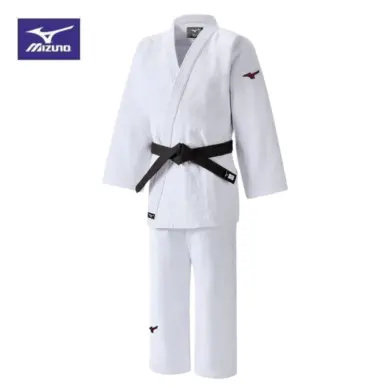
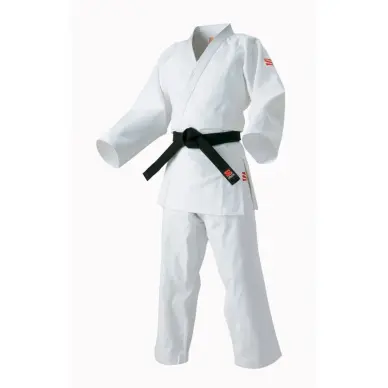
The judo gi, also called judogi, is essential equipment for practicing judo under optimal conditions. It consists of a jacket (uwagi), pants (zubon), and is paired with a belt (obi). Unlike regular sportswear, the judogi must withstand grabs, pulls, throws, and friction on the tatami.
From lightweight 180 g/m² judo gis for initial training to thicker competition judogis, each model meets specific needs.
At Budo-Fight, find notably BudoFight judo gis, Adidas, Mizuno, KuSakura, and Noris judogis, with models designed for different practice levels.
To complete your outfit, also check out our other useful dojo equipment and accessories.
How to Choose Your Judo Gi?
The choice of a judogi mainly depends on the practitioner's age, level, training frequency, and intended use.
A child starting judo will prefer a lightweight, flexible, and comfortable outfit. A judoka training several times a week will seek greater durability. A competitor must also consider their federation’s rules.
Several criteria are important to choose the right gi:
Fabric weight, expressed in g/m², which helps compare fabric density.
Composition, usually cotton or a cotton-polyester blend.
Weave, especially the rice grain weave characteristic of many judogis.
Cut and size, which must ensure good freedom of movement.
Reinforcements and seams, essential to withstand grabs and throws.
IJF approval, when competition requires it.
The best judogi is not necessarily the heaviest or most expensive. It must above all suit your practice.
For more details on these criteria, consult our guide to compare and choose your judo gi.
Which Fabric Weight to Choose for a Judo Gi?
The fabric weight of a judo gi, expressed in grams per square meter (g/m²), is a key factor in selecting a judogi suited to your level.
It corresponds to the mass of one square meter of fabric and indicates its density.
A lightweight judogi generally suits children and beginners better, while a denser gi is often preferred for intensive training and certain competitive practices.
At Budo-Fight, you will find various fabric weights, from 210 g/m² beginner judogis to heavier gis designed for experienced judokas.
Comparative Table of Judo Gi Fabric Weights
Fabric Weight | Reference Model | Recommended Use |
|---|
180 g/m² | BudoFight Initiation | First classes, young children, and judo introduction |
350 g/m² | BudoFight Super Initiation | Children and beginners seeking a first rice grain judogi |
500 g/m² | BudoFight Training | Regular training, technical progression, and more structured fabric |
650 g/m² | BudoFight Super Training | Experienced judokas and intensive training |
800 g/m² | BudoFight Setsugi Slim Fit | Intensive practice and competition according to applicable rules |
900 g/m² | BudoFight Mondial Slim Fit | Judokas seeking very dense fabric, depending on authorized usage conditions |
The indicated fabric weights correspond to the announced characteristics for the reference models and may vary depending on versions. Always check the technical sheet before purchase. The fabric weight usually refers to the jacket; the pants fabric weight may differ.
Important: a high fabric weight or the mention "competition" does not automatically mean a judogi has IJF approval.
Judo Gi 180 to 350 g/m²: For Children and Beginners
Judo gis with weights of 180 and 350 g/m² are particularly suitable for beginners.
The BudoFight Initiation 180 g/m² prioritizes lightness and comfort for the first training sessions.
The BudoFight Super Initiation 350 g/m² offers a step up with its rice grain weave, ideal for young judokas who are progressing.
These models are a great way to discover judo without immediately investing in a gi designed for intensive practice.
Judo gi 500 g/m²: the perfect balance for training
The BudoFight Training 500 g/m² features a more structured fabric, suitable for judokas who train regularly.
It is an interesting choice for practitioners seeking a balance between durability, comfort, and freedom of movement.
This weight category is especially suitable for judokas who start increasing their weekly training sessions.
Judo gi 650 to 700 g/m²: for advanced judokas
The BudoFight Super Training, with a weight around 650 g/m² depending on the model, is designed for advanced judokas who want a durable gi for intensive training.
In a similar weight range, the KuSakura JOEX Ichiban IJF at 700 g/m² is a model intended for competition.
These gis feature a denser and more structured fabric, appreciated for repeated grips and demanding judo practice.
Judo gi 800 g/m²: for demanding practice
The BudoFight Setsugi Slim Fit 800 g/m² is designed for judokas seeking durable equipment, especially for intensive practice.
Its rice grain fabric and reinforcements are adapted to the stresses of combat.
Note: weight alone does not determine if a gi is allowed in competition. For international events, check the IJF approval of the model and its compliance with current regulations.
Is a heavier gi always better?
No. A higher weight does not automatically guarantee better quality or greater durability.
The quality of the weave, reinforcements, fabric composition, and stitching also play essential roles.
The best choice mainly depends on your level, body type, and training frequency.
Judo gi for children and beginners
For first training sessions, choose a lightweight, comfortable, and sufficiently durable judo gi for children.
The priority is to allow the young judoka to learn techniques, move freely, and discover the first throws under good conditions.
At Budo-Fight, the Initiation and Super Initiation models are particularly suitable solutions for early classes. The choice depends on the child’s size, session frequency, and the fabric desired.
Essential criteria for a children’s gi
A good gi for children should offer:
A comfortable fabric suitable for beginners.
A cut that allows free movement.
Stitching strong enough to withstand grips.
Easily adjustable pants.
A size adapted to the child’s body shape.
Avoid choosing a gi that is excessively large to anticipate several years of growth: an overly loose outfit can hinder movement and techniques.
Judo gi for regular training
As the judoka progresses, demands increase.
Technical repetitions, training fights (randori), throws, and groundwork put strong strain on the gi.
For regular practice, choose a durable judo gi with fabric suited for grips and well-placed reinforcements.
The BudoFight Super Training is a reference to consider for this use.
Why choose a rice grain gi?
Rice grain fabric is recognizable by its raised weave, commonly used for judo jackets.
This structure helps the fabric hold its shape and is part of the traditional features of many judo gis.
To compare two rice grain models, examine their weight, composition, and finishing details.
Judo gi for competition
The competition judo gi must meet specific requirements.
Besides durability and comfort, regulations may impose precise dimensions regarding the jacket, pants, sleeves, and collar.
For international competitions governed by the International Judo Federation (IJF), specific approval may be mandatory.
At Budo-Fight, find models designed for competition, including those from BudoFight, Adidas, Mizuno, and KuSakura.
To discover other Japanese references, also check KuSakura brand gis.
What is an IJF-approved gi?
An IJF-approved gi is a gi that meets the technical requirements defined by the International Judo Federation for the relevant competitions.
These requirements include:
The dimensions and cut of the gi.
The fabric characteristics.
The conformity of the jacket and pants.
The approval markings and labels.
The rules regarding the attire worn in competition.
A very heavy judo gi or one presented as a competition model is not automatically IJF approved.
Before participating in an official event, check the applicable rules and the compliance of your reference.
Consult the regulatory documents of the International Judo Federation to know the current requirements.
Which material to choose for your judo gi?
Judo gis are generally made of cotton or a blend of cotton and synthetic fibers.
Cotton judo gi
Cotton is a traditional material, appreciated for its feel and textile qualities.
Depending on its weave and weight, it can offer a soft or particularly structured fabric.
However, cotton may shrink when washed: check the manufacturer's recommendations.
Cotton and polyester judo gi
Some judo gis combine cotton with polyester.
These blends allow different fabric characteristics depending on the proportions used and the garment's construction.
The composition should always be examined along with the weight, cut and quality of the seams.
The importance of reinforcements
The shoulders, armpits, chest, collar and certain seams are particularly stressed during grips.
Appropriate reinforcements contribute to the gi's durability.
The pants must also withstand bending, movement and repeated friction on the tatami.
How to choose the size of your judo gi?
Judo gi sizes are generally indicated in centimeters and correspond to the practitioner's height.
To choose your judo gi size, measure your height and consult the manufacturer's size guide.
The jacket should allow techniques to be performed without restricting the arms.
The pants should accommodate bending, throwing and groundwork.
To find the right match, see our practical size guide for gis.
Children's judo gi: which size to choose?
For a child, choose a size adapted to their current height while considering possible shrinkage.
A gi that is too large can hinder movement and make learning less comfortable.
Adult judo gi: classic cut or slim fit?
Some manufacturers offer different cuts, including more fitted models.
A slim fit cut may suit judokas who prefer a less loose jacket, provided the required dimensions for their practice are maintained.
Size and cut indications vary by brand. Always check the guide corresponding to the chosen model.
If you are considering a gi from this Japanese brand, also consult the size correspondences specific to Mizuno models.
Judo jacket and pants: what are the differences?
The judo gi mainly consists of a jacket and pants.
The judo jacket: uwagi
The jacket, called uwagi, is heavily stressed during grips and throws.
Its fabric, collar, seams and reinforcements contribute to its durability.
The quality of the jacket is therefore an essential criterion for comparing judo gis.
The judo pants: zubon
The pants, called zubon, must offer good freedom of movement.
They accompany movement, bending and groundwork.
Depending on the models, they may be equipped with an elastic waistband, a drawstring or knee reinforcements.
The weight of the pants may differ from that of the jacket. So be sure to check the detailed product specifications.
BudoFight, Adidas and Mizuno: which judo gi brand to choose?
At Budo-Fight, you can compare several brands of judo gis according to your level, budget and practice.
BudoFight judo gis
BudoFight judo gis cover different needs, from initiation to regular training.
The range allows comparison of lightweight models for children and more structured gis for progressing judokas.
BudoFight is an interesting choice for finding a good balance between quality, comfort and price.
Also discover the equipment developed by our BudoFight brand.
Adidas judo gis
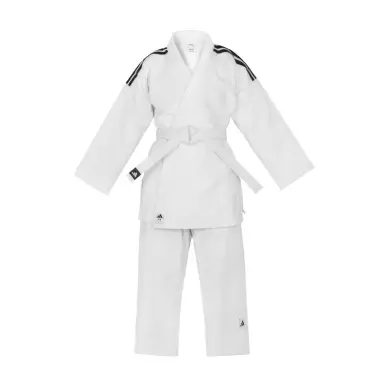
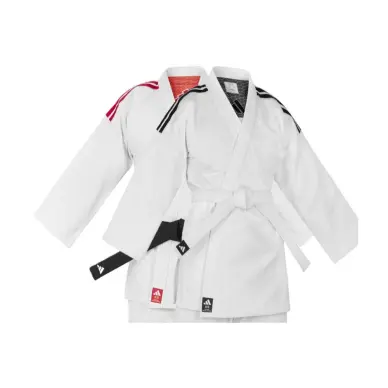
Adidas judo gis include models for beginners, regular practitioners and competitors.
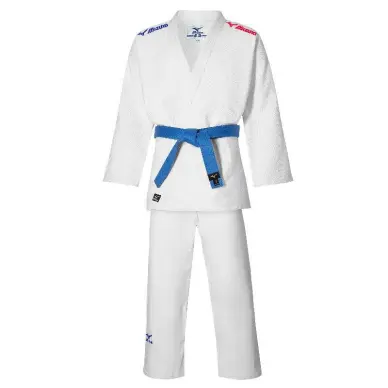
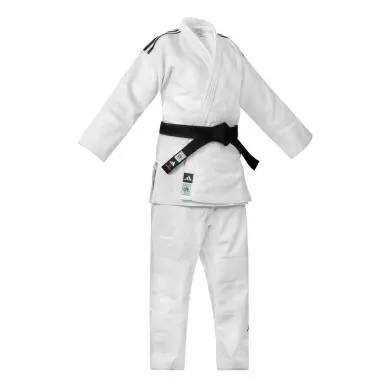
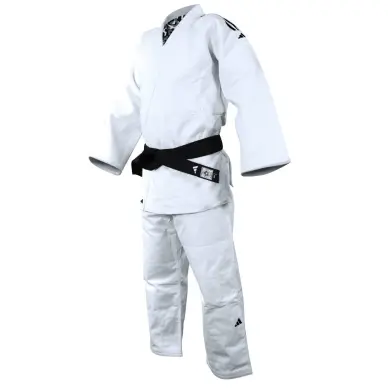
The brand is notably recognized for its competition gis, including the Champion III IJF.
Adidas offers different solutions for judokas seeking equipment adapted to their level.
Find also the various Adidas martial arts collections.
Mizuno judo gis
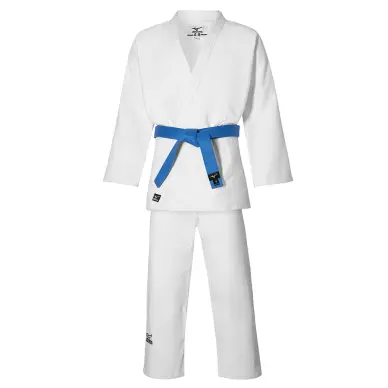
Mizuno is a Japanese brand particularly renowned for its high-end judo gis.
It holds an important place in the competitive judo world, notably thanks to its Yusho IJF range.
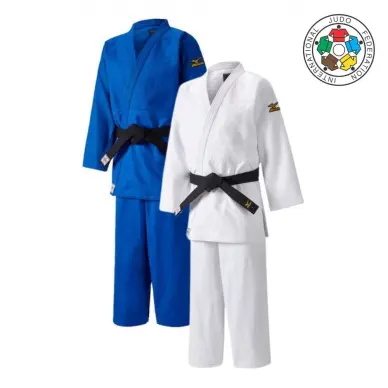
Among its references are the Mizuno Yusho IJF, Yusho Best IJF and Yusho Made in Japan IJF, appreciated for its Japanese manufacturing origin.
Discover the range of Mizuno gis and accessories to compare models from this brand.
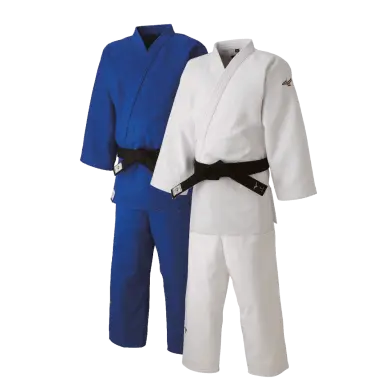
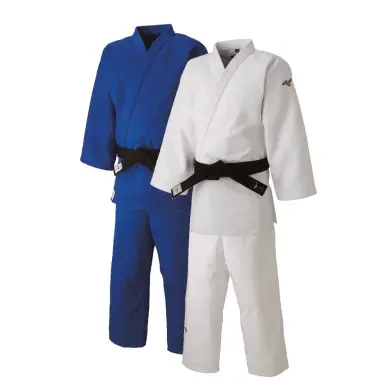
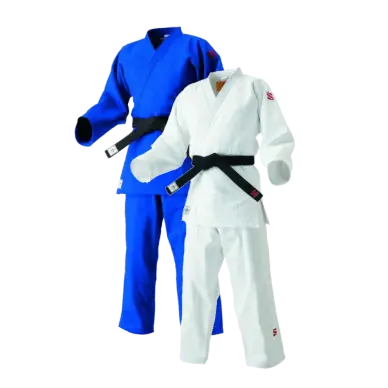
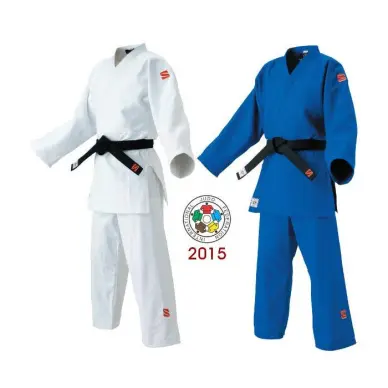
White or blue judo gi: which one to choose?
White judo gis are traditionally used in clubs and training.
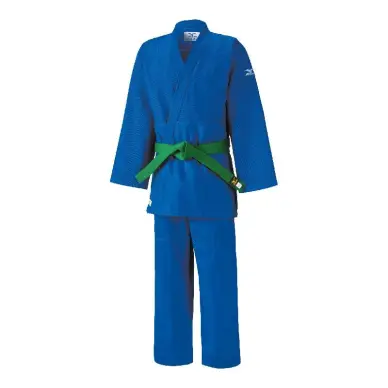
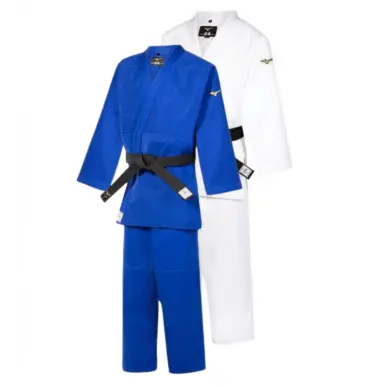
Blue judo gis are also common in competition judo, where colors help distinguish competitors.
For a child or beginner, white is generally the simplest choice.
For a competitor, the requirements depend on the rules of the events they participate in.
Before buying a blue judo gi, check the guidelines of your club and federation.
How to care for your judo gi?
Proper care helps preserve the quality and lifespan of your judo gi.
After each training session, take your gi out of the bag and let it dry in a well-ventilated area.
Follow the washing instructions on the label.
Avoid excessive temperatures that could cause shrinkage or damage certain finishes.
Regularly inspect the seams, reinforcements, and pants.
For judokas training several times a week, having a second judo gi can make it easier to alternate between sessions and washes.
What accessories to buy with your judo gi?
To complete your gear, several accessories can be useful.
Judo belt
The judo belt is essential to keep the jacket closed.
Its color corresponds to the practitioner's rank.
Choose a length suitable for tying a stable knot.
Discover our selection of belts suitable for different ranks.
To determine the right length, also check our advice on martial arts belt sizes.
Sports bag
A sports bag allows you to carry your judo gi, belt, and training gear.
For regular practice, choose a bag that is spacious enough and easy to ventilate.
Find especially our bags designed to carry your judo equipment, available in various sizes for children and adults.
Equipment for other combat sports
If you practice multiple martial arts, consider choosing a specific outfit for each discipline.
The karate outfits generally emphasize different features than a judo gi, especially for striking movements.
The BJJ gis are also designed for grappling and ground fighting, but their cuts and competition requirements may differ.
To move around the dojo off the tatami, also check out our practical sandals for judokas.
Buy a judo gi online at Budo-Fight
Buying a judo gi online allows you to easily compare models based on weight, fabric composition, size, and price.
Before ordering, check the technical specifications of each judo gi.
Also verify the availability of the desired size, delivery times, and applicable return conditions.
If you are buying a judo gi for an upcoming competition, allow enough time to check the size and compliance of the outfit.
At Budo-Fight, find gis suitable for all practice levels, from beginner judo classes to competitions.
Why buy your judo gi at Budo-Fight?
Since 1963, Budo-Fight has supported martial arts practitioners and offers a selection of judo gis adapted to judokas’ needs.
Whether you are looking for:
A child’s judo gi for first training sessions.
A lightweight judo gi from 180 to 350 g/m² for beginners.
A 500 g/m² judo gi for regular practice.
A durable judo gi for intensive training.
An IJF-approved gi for relevant competitions.
A judo gi by Adidas, Mizuno, KuSakura, or BudoFight.
You can compare available references by cut, durability, comfort, and your budget.
Frequently asked questions about judo gis
What is the difference between a judogi and a kimono?
The judogi is the precise name for the judo kimono. Both terms refer to the same practice outfit, consisting of a jacket and pants, usually worn with a belt. The term “judogi” is more specific, while “kimono” is widely used in everyday language.
How to choose your judogi?
To choose a suitable judogi, consider the weight, fabric composition, cut, size, color, and your training frequency. A lightweight model often suits beginners; a denser judogi may be preferable for intensive practice. For competition, also check your federation’s requirements and, if needed, IJF approval.
Which brand should I choose for my judogi?
Several brands meet different needs. Mizuno is known for its competition judogis and Japanese craftsmanship. Adidas offers a varied range, including cuts adapted to different body types. BudoFight provides interesting models from beginner to advanced practice. The best choice depends mainly on your level, budget, and preferred cut.
How to keep my judogi in place during training and competition?
During grips and randori, the judogi jacket can shift or open: this is normal in a grappling discipline. To hold it better, cross the panels correctly and tie your belt firmly without restricting your movements.
To learn the method, consult our guide to properly tie the judo belt.
How do I wash my judo gi?
After training, air out your judo gi quickly and always follow the instructions on the label. Washing at 30 or 40 °C may be suitable for many models, but the temperature depends on the fabric and manufacturer. Avoid assuming all judo gis can withstand very hot water or the dryer: these practices can cause shrinkage, especially on cotton-rich models.
How do I remove stains from my judo gi?
In case of blood stains, first rinse with cold water, as hot water may set the stain. Then gently treat with a stain remover compatible with the fabric, and wash according to the manufacturer's recommendations. For other stains, always test the product on a small, inconspicuous area to preserve color and fibers.
What can I wear under my judo gi?
At training, clothing allowed under the judo gi depends on club rules: a t-shirt or technical underwear may be accepted. In competition, rules are stricter. According to applicable regulations, female judokas must wear a compliant t-shirt under the jacket, while male judokas generally do not wear a t-shirt. Always check the rules of your federation and the specific event.